
How do we write about war?
Veterans often rewrite their traumas. Author Ian Cosh pushes beyond the fictions to the truth.

As a novelist, I’m fascinated by the fictional nature of the everyday stories we tell, especially about the worst things we face. In a way, everyone is a writer. A rewriter, anyhow. Especially people like war veterans, who have a great deal they want—and maybe need—to paper over.
Maybe you’re a veteran, or know people who are or were. Most of us do.
Read on for part two of a look at a new release from Ian Cosh.
I asked anthropologist Ian Cosh why he’d decided to interview Canadian war veterans for his first book. There was a pause.
“Gosh,” he said. “Yeah, you know, like, it’s… some of these are the sorts of things where I might remember something more that I can email you later?”
We laughed a bit, since Cosh’s book is largely about memory. Specifically, it’s about the way people who experience trauma often try to repress memories of what happened. These can be memories of rape or a natural calamity, although in this case, Cosh is writing about war. Yet whatever the trigger, the sounds and images have a bad habit of showing up anyway—jumbled, the dates mixed up, the worst parts papered over, but insistently there, an injury that refuses to heal.
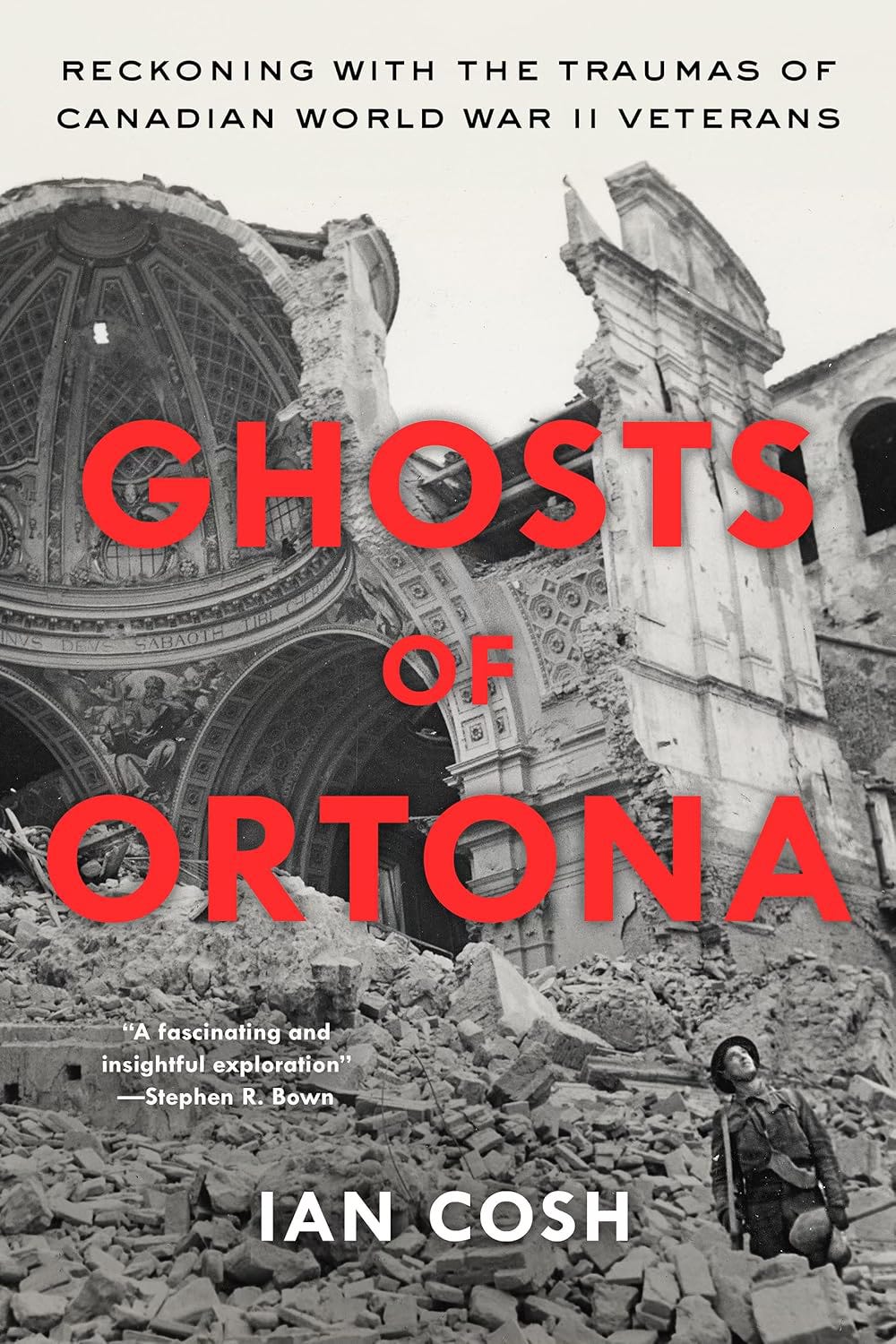
Cosh is the author of Ghosts of Ortona: Reckoning With the Traumas of Canadian World War II Veterans. As I wrote last time,[1] the book is rooted in the ethnographic research Cosh did for his PhD at York University in 1999 and 2000. He interviewed more than a dozen Canadian veterans who had battled Nazi troops over Christmas, 1943, a bloody campaign in the Italian town of Ortona.
After Cosh got his doctorate, he put the subject aside. Yet the old soldiers haunted him, his own ghosts of Ortona. Years later, he reopened his boxes of research and wrote the book, which was published this spring.
Why?
Why did he do the research in the first place? Why go back to it 30 years later?
Why do any of us write what we write? A dissertation, a book—even a review.
These are questions that have always fascinated me.
In this case, a writer friend sent me an email about Ghosts of Ortona. She’d read a recent book review I’d written that mentioned my difficult and damaged father.[2] He was a World War II vet who had fought in the invasion of Sicily and then, I was told, in the battle of Ortona. Both were harsh and bloody campaigns, and I’d always felt they left him with Post Traumatic Stress Disorder.
If your father fought at Ortona, my friend said, you have go to Ian Cosh’s book launch. Obediently, I did, and as I listened to Cosh speak, I was intrigued by his ethnographic approach to the veterans and their stories, which makes his book far different than the usual military history. It raised all sort of questions, so I read the book, and afterward he kindly agreed to do a video call.

“Gosh,” wasn’t the most encouraging start. No blame; I’d started by asking Cosh to excavate a decision made almost 30 years ago. But memory is central to his book, and I wanted to know why Cosh had chosen to do his dissertation on the vets. Had someone in his family fought at Ortona, like my dad?
No, he said. But when he was a teenager, he’d lived in Italy with his family. He spoke the language pretty well and had always wanted to go back. At the same time, he had an interest in Canadian history, even though he’d lived outside Canada when he was young. One Hallowe’en while he was in elementary school, he’d dressed up as a soldier from the Battle of Quebec.
Cosh mentioned the usual search for research funding, and semi-remembered several other projects that didn’t fly. Then he recalled a colleague showing him a newspaper article about a delegation of Canadian veterans hoping to visit Ortona. The commemorative trip promised to satisfy his interest in both Canadian history and Italy, and Cosh decided to tag along. Serendipitously, his research was underway.
I linger on this point because writers begin projects for very different reasons, and the way we do affects the books we produce. Sometimes we have a clear idea of why we’re writing a manuscript, a gift that propels the work forward.
Often, though, writers are magpies like Cosh, our projects woven together from half-understood impulses like nests made of twigs, string and sparkly bits of tinfoil. That’s significant, because it means we can take a while to understand what holds our material together, as Cosh did.
By this I mean finding the theme that connects our scribblings; discovering what the book is actually about.
A theme can come far more slowly that many readers realize. Yet as we look for connections between tinfoil and twigs, writers end up approaching their material in novel ways.
And being forced to step back and consider that material (although hopefully not for 30 years), allows writers to find the depth of insight Cosh provides, which in this case made me weep.
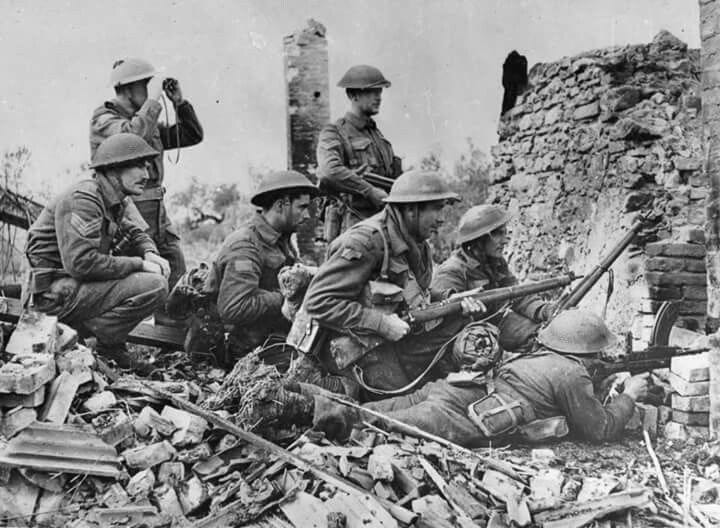
The man who organized the commemorative trip to Ortona in 1998 was a former soldier named Edward (Ted) Griffiths. As a 21-year-old corporal, Ted had fought in Ortona with the Three Rivers Tank Regiment, and he wanted the return trip to focus on peace and reconciliation. Thirty-six Canadian veterans and a phalanx of media travelled with him. Six German veterans of Ortona met them there, and Ted hoped for rapprochement.
Unfortunately, his hope was only semi-shared by some of the Germans. One of the Wehrmacht vets Cosh interviewed turned out to be an unregenerate old Nazi, angry at the German government for refusing to let World War II veterans wear the medals they’d received from Hitler. He was both racist and anti-Semitic, although he cherished a sentimental admiration for the British Empire.
“And the Jews… they’re controlling the whole world with, you know that story?” he asked Cosh, then broke down sobbing when he talked about the death of a soldier from New Zealand.
Ted Griffiths, on the other hand, was both a devout Christian and a liberal. When he and Cosh first met, Ted was fixated on the time he’d destroyed the façade of a church on Christmas Day.
“He was driving his tank down a street in Ortona,” Cosh writes. “He was supporting a group of Seaforth infantry men.” (Soldiers from the Seaforth Highlanders, another Canadian regiment.) “They entered a square. Across from them was an old church and a hospital. Suddenly, the Seaforths outside Ted’s tank were dropping. ‘They all fell down like a bunch of dolls.’ Germans were shooting them from a heavy machine gun inside the church. Ted directed the gun of his tank at the church, and fired. The shot blew in the whole church face, burying the Germans inside.
“He looked up at me from the binder.
“’That’s how I spent my Christmas.’”
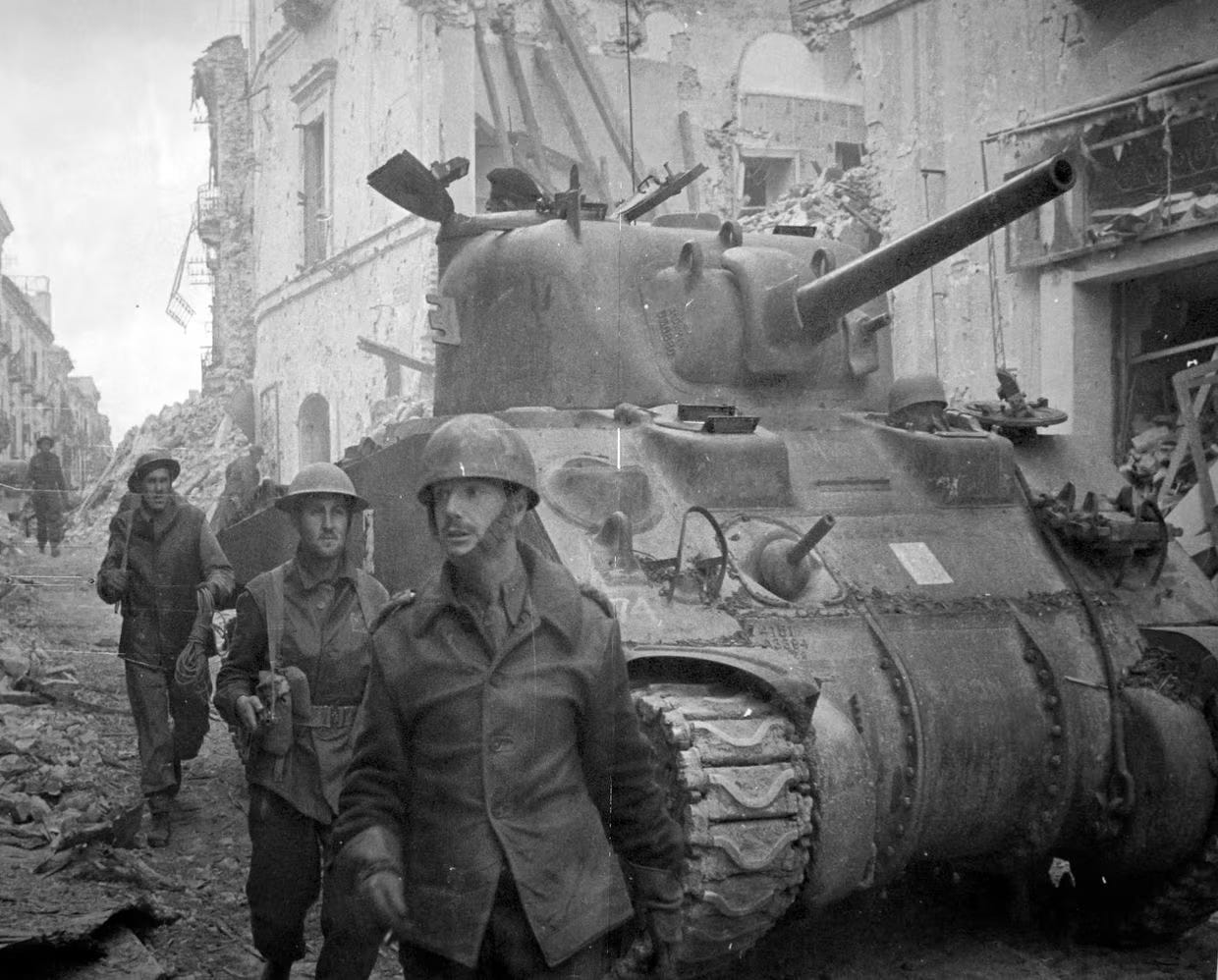
Ted portrayed the event as central to his anguish over the war, as well as to the catharsis he’d felt on his first post-war visit to Ortona in the early 1990s. He told Cosh that he’d sat in the rebuilt church and sobbed. The peace he felt afterward was part of the reason he gave for organizing the commemorative visit, hoping that others would feel it, too.
Yet as Cosh wrote his book, years after Ted had died, he had one of those insights that distance can provide, realizing that there were discrepancies in Ted’s stories about fighting in Ortona. Dates didn’t quite match up, and Cosh discovered a significant omission. Reading a memoir Ted wrote after they’d talked, Cosh came across a story Ted had never told publicly about a brutal act of violence in Ortona—not on Christmas Day, but Christmas Eve.[3]
“Making my way through the narrow, pitch-black street,” Ted wrote, “I grew increasingly nervous for I didn’t encounter a soul, not could I detect the presence of any infanteers. It was quiet as a tomb, something quite unusual instead of the normal crash of gunfire. Uncertain, I stopped at a corner where I tried to orient myself.
“Suddenly, in the silence, I became aware of approaching footsteps. Not knowing who it was, and unsure where I was, I didn’t want to make any noise by using my pistol if I were forced to, so I quickly removed a commando knife I carried in the sleeve of my tunic. The faint glimmer of a silverized belt buckle as the person rounded the corner told me that he was German.
“Lunging forward I drove the knife in deeply just above the belt buckle then swiftly drew it upwards effectively gutting him before he could utter a sound. Realizing I was in German territory I turned to retrace my steps and eventually made contact with the Seaforths without further incident.
“Over the next day or two I saw the German body of Christmas Eve still slumped against the wall, and one day I stopped to go through his pockets where I found his field service book only to discover he hadn’t yet reached his 17th birthday. Given the brutality of the day I thought nothing more of the incident but, with passage of time, it has increasingly haunted me—and continues to do so to this day. Time has taught me how easy it is to kill, but how hard to forget.”
Was his story of blowing up the church a screen memory, as psychoanalysts call them? Something Ted talked about to paper over the time he’d saved his life by gutting a 17-year-old kid?
Or was it something else? Ted’s story leads to a key insight in Cosh’s book.
“An effort to avoid (our worst) memories or completely erase them from our minds,” he writes, “can limit our ability to tell a coherent and satisfying story of our life—which makes it difficult to feel real and authentic in the world. The emotional strain of incomplete repression, avoidance and broken sense of self, harms our ability to relate well with others.
“One of the ways that the mind tries to remedy this is by finding a workable and less threatening substitute for the traumatic memory… more benign and comfortable to recall. The substitute’s proximity allows some of the feelings about the event to be displaced onto it… thus sparing us from having the confront the worst details… All of this facilitates the telling of a story from that time in our life which makes sufficient sense to ourselves and others without breaking our mental and moral composure.”
When he destroyed the church, Ted killed the Germans inside, but he never saw them. The Seaforths just stopped getting shot. So there was plenty of upside to blasting out the façade and no downside that he could actually see.
Cosh writes that sturdy men and women can fight through war and emerge in decent shape. But what comes across very clearly in his book is that many soldiers can’t kill an identifiable person without carrying the death with them all their life.
A brief Interview
On our video call,[4] I asked Cosh what he thought about the idea of agency. In the book about World War II that I reviewed earlier, The Wounded Generation, historian David Nasaw quotes an American soldier as saying he felt expendable. Small. Nothing but cannon fodder.
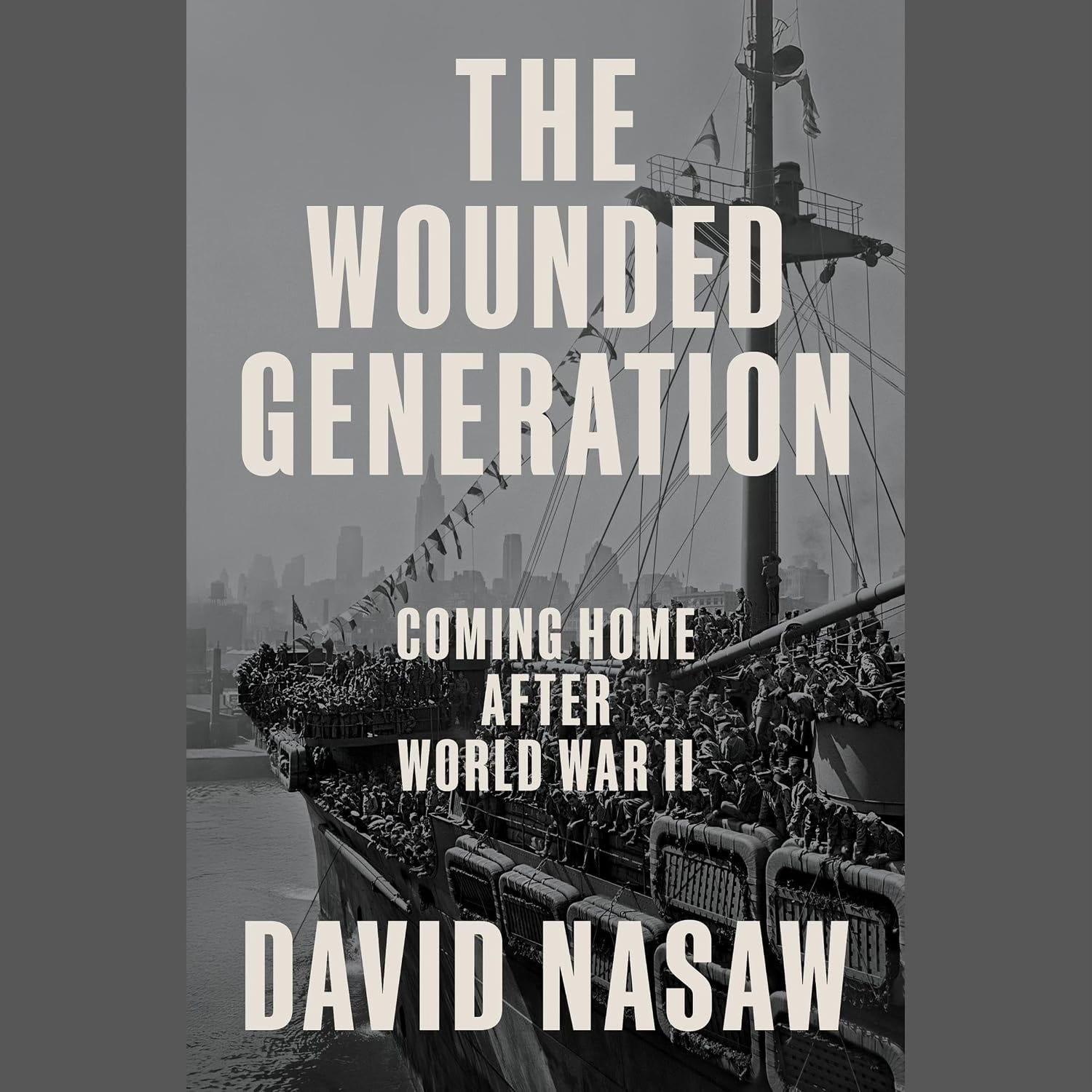
I asked whether this was something Cosh came to feel was true of the men he spoke with. Did he come to believe that the veterans were doing more than trying to paper over their memories? Were they seeking to assert control of their experiences through the stories they told?
“The question of agency is something that comes up in the literature a lot,” Cosh said. “And yeah, I think they did lose a sense of agency and were trying to reclaim it in their stories, and in their ways of dwelling on certain actions.
“For example, Sam (Lenko) told a story of an action in which he shot Germans alongside his sergeant, Hately. And it struck me, especially at the time when I was there listening to him: Am I hearing this correctly?
“Because why is he dwelling on this? You’re there to shoot Germans in a battle. They’re shooting back at you. Yet the way he was talking, it was as if there was some kind of a crime scene here, and I didn’t get it. Were there things he wasn’t telling me?
“And so one factor there could be agency. It’s not satisfying as an individual to be told, or to tell yourself, that I was just part of a military apparatus.
“One of the things I find interesting is that there’s a kind of insistence (among soldiers) on taking responsibility when you have the option of not taking it. That’s a point that’s raised by Joanna Bourke of the University of London in a book called The Intimate History of Killing. In reviewing letters and diaries and stories from soldiers who fought in both world wars, she said she was struck by how soldiers insisted on taking responsibility or considering their responsibility even when nobody was expecting them to.”
I told Cosh that one of the things I find particularly interesting about Ghosts of Ortona is that while most books about war concentrate on generals and politicians, the higher-ups, his book is focused on lower ranks. Grunts, they called themselves.
Did their lesser status lead to insistence that they mattered? The generals were wrong. They were important. Is that why they insisted that they were responsible for what happened?
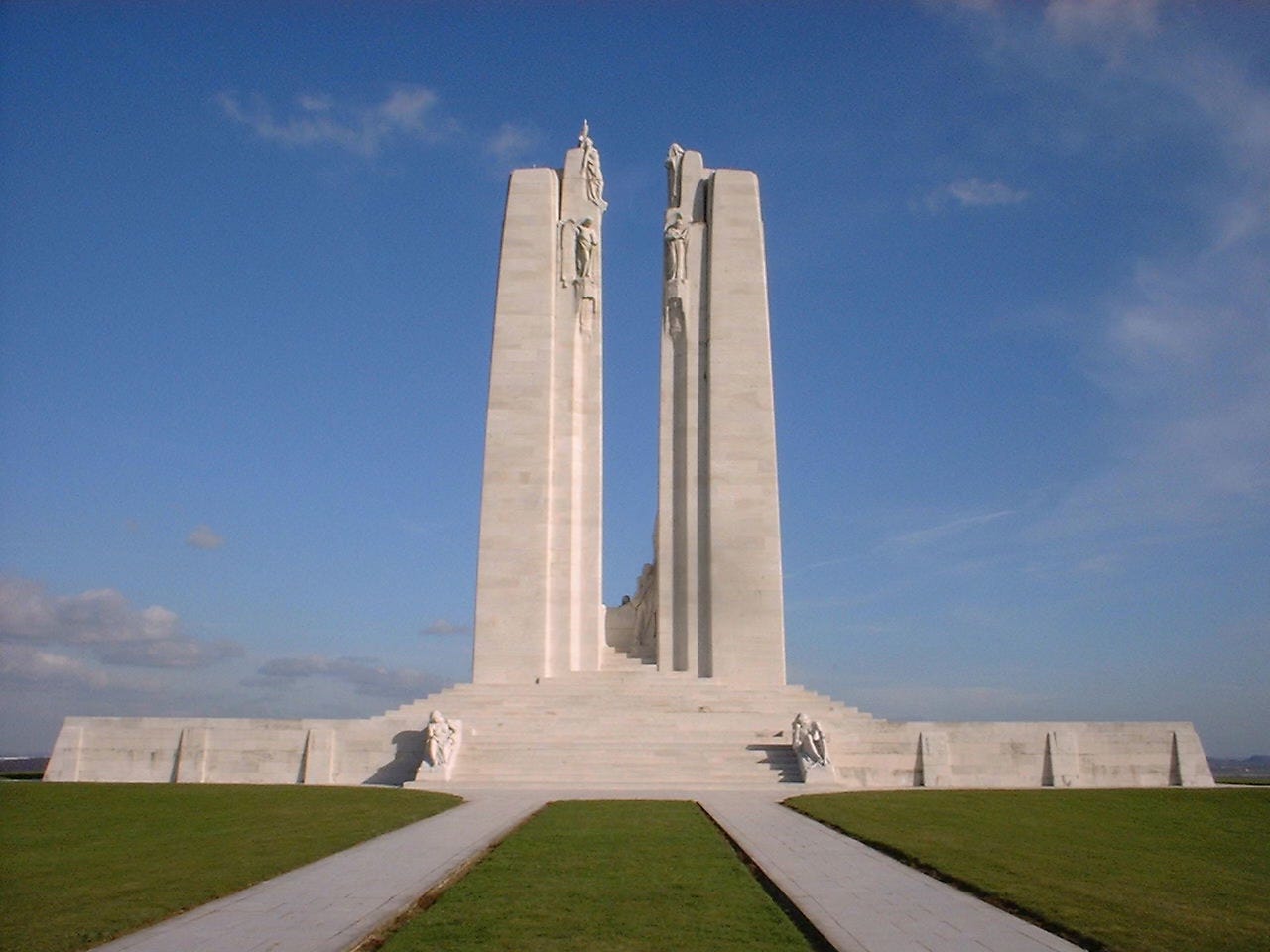
“I have many thoughts at once,” Cosh said. “One of them involves Paul Fussell’s book, The Great War and Modern Memory, where he focused a lot on the literature that came out of World War I.
“Many of the stories from the Western Front are kind of about hopelessness and smallness, maybe because of the nature of trench warfare. But it’s also been pointed out that many of the stories that are quite famous were written by men with a more literary frame of mind, more modernist or philosophical, and more of a willingness to question what went on. Wilfred Owen. Robert Graves.
“Yet many of the men who came home from that war did not want to believe that it was hopeless. And you could say that they were right, that the war did have meaning, and the way the Canadians took Vimy Ridge, for one thing, was a great achievement. And I don’t think that’s 100 per cent untrue.
“But I also see in that an emotional motivation to believe that your actions mattered, and that what you did mattered; that the sacrifices mattered.
“I also think of myself, and how it’s hard feeling that there’s not much I can do when I see terrible things happening in the world.
“Sometimes I wonder why I watch the news every day. Why do I follow, every day, what’s happening in Gaza? And watching (Donald) Trump is like watching a train wreck—although in that case, it’s headed my way, so actually there are reasons of self-interest to follow that one. But why the daily ritual of following news in distant parts of the world where I don’t need to, and where it feels like there’s not much I can do about it?
“And then I think to myself, at least I’m doing that. Although that’s maybe a bit different from a question of control. That’s maybe of a more spiritual matter.”
“We have to justify our existence somehow, don’t we?” I asked Cosh.
“Yeah. And then maybe what happens to people who’ve experienced war is that they’ve seen what’s at stake, and they’ve lost a lot, both soldiers and civilians. So maybe they tell themselves: if we tell stories involving agency, we can redeem all of this with some sense of achievement.”
A pause.
“Although I think we do that too much,” he said.
Next time, I plan to write a more personal post about my father, the traumatized World War II vet. Stay tuned.
[1] You can read my earlier post about Cosh’s book by clicking on this link. Ghosts of Ortona is available at indie book stores, or you can order it here. The book is published by Sutherland House.
[2] This was a review of The Wounded Generation: Coming Home After World War II, written by historian David Nasaw and published by Penguin Press. You can read my review here. It contains a hyperlink that lets you order the book.
[3] Ted Griffiths wrote his account as one long paragraph, but I’ve broken it up here so it’s easier to read on electronic devices.
[4] Before you ask, in future, I plan to post audio clips occasionally, but I need to take voice training first. A project for the fall. One of my friends claims she can train me, and she has a beautiful speaking voice. But is yogic breathing alone going to work? A small personal project for later this year.
Thank you, Lesley. As you know, I've been more interested in the civilian stories, but this is all so sad. The killing of the German boy soldier stands out, which tells you how these individual stories are so important in trying to gain some understanding.
Please disregard my questions from the previous post. I see now that you'll write about your father next time.
Fascinating and heartbreaking. I'm always keen to read about how people endure after these kinds of experiences.
My wife's paternal grandfather flew for the RAF in a bomber in the Battle of Britain (among many other campaigns), lost the best man from his wedding along with countless other people, then came home and became a school teacher and, according to my father-in-law, never mentioned the war again. Not once! By all accounts, he wasn't a drinker, never particularly lashed out at anyone... and I'm always wondering, how did he carry all of that? And was he okay, or was he privately suffering terribly? It must have affected him deeply, and cost him dearly not to show it.
I hope some of the WWII folks are able to say, at least, that it was defeating the Nazis, and fascism, which was obviously as good a cause for fighting a war as there's ever been... but still. I'm so struck by the moment you describe where the Canadian soldier had to stab a sixteen-year-old—what a thing to carry. These infantry soldiers, in particular, and especially in more recent wars with less obvious overall benefit to humanity, I wonder how they survive the aftermath. I guess many of them don't.
It's certainly very helpful to share these stories of peoples actual experiences, and their way of coping with memories. "Screen memory" is such a fascinating concept.
Anyway, I'm endlessly curious and wondering about these types of stories, so I'm grateful you're doing these reviews and interviews. Thank you for this, Leslie!